A roof coating proposal can look affordable until a moisture survey reveals wet insulation that needs to be addressed. If the owner has already arranged financing around the original price, the added work can put the entire project in jeopardy.
That was one of many great points Adam Capps brought to the 2026 Roof Coatings Manufacturers Association (RCMA) Fall Meeting in Atlanta. Adam founded Roof MRI and ReDry after working as a commercial roofing contractor.
As mentioned in our RCMA meeting recap, several sessions covered evaluating a roof before recommending restoration. Adam explained why that evaluation needs to happen before the contractor submits a price.
Find the Moisture Before You Price the Work
 Adam opened with a project from his contracting years. His company had invested considerable time in a large roofing opportunity, but the moisture survey came after the contract was signed. It identified extensive wet insulation that would add substantially to the cost.
The contract included a price for addressing that condition. The owner, however, had already arranged financing and investor contributions. Having a provision in the contract did not create more money in the construction budget.
The project fell apart.
A contractor may include a price for additional work in the proposal, but that does not mean the owner has the money to pay for it. By then, both sides have invested time in a project built around a budget that no longer covers the work needed.
Adam illustrated the problem with a separate pricing example. For a 100,000-square-foot roof, he used a coating price of $4 per square foot, or $400,000. Adding a $12-per-square-foot tear-out allowance for wet insulation affecting 13% of the roof increased the total to $556,000.
That is a 39% increase over the original coating budget. These were assumptions in his presentation, not a price guide, but they made the timing problem easy to understand.
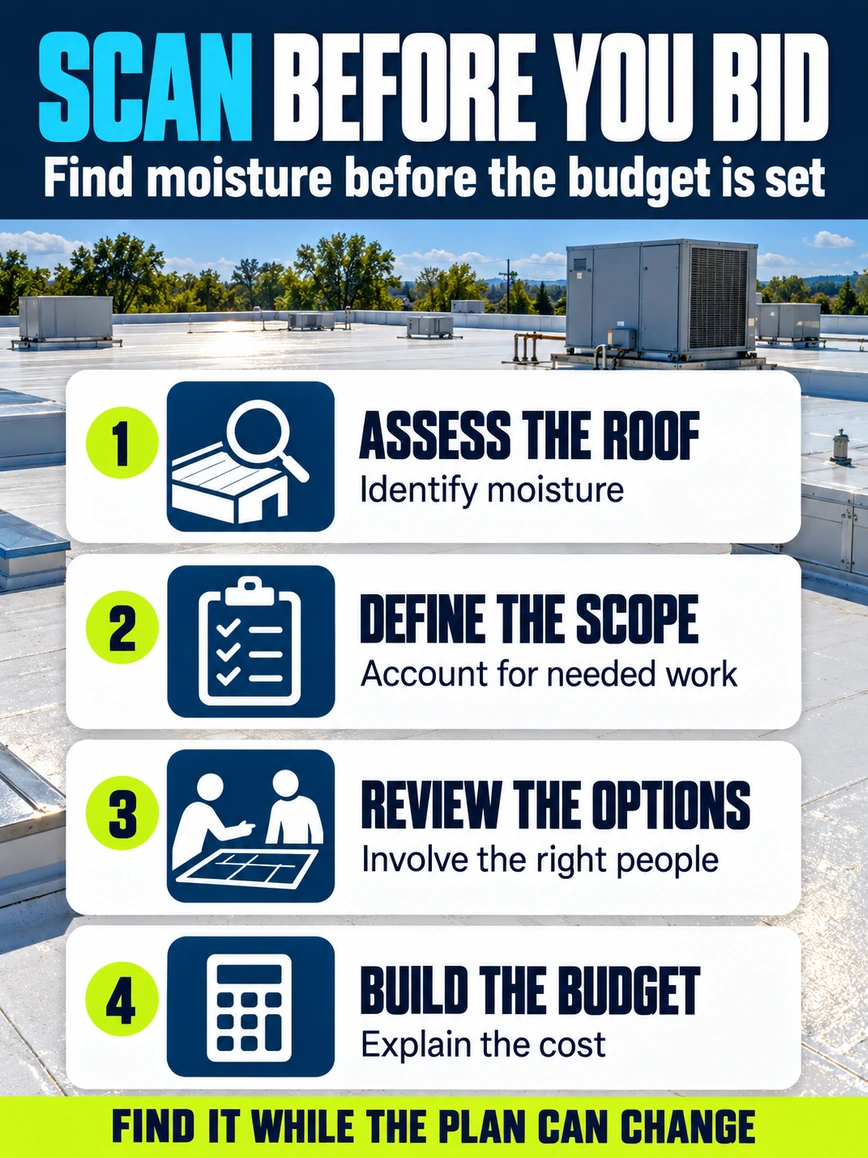
Finding the moisture earlier gives the contractor time to define the scope, discuss alternatives, and involve the manufacturer before presenting a number the owner may use to arrange financing.
The work may still be expensive. The difference is that everyone can account for it while the plan can still change.
Understand What the Findings Mean
Adam explained how Roof MRI trains contractors to assess moisture conditions and helps them prepare reports on their findings. ReDry uses a solar-powered vent system to remove moisture from roof assemblies that are suitable for drying in place.
Adam described differences between insulation that is thoroughly wet and material that is damp. In some cases, water can be squeezed out of the insulation. In others, the moisture is less obvious. His research slide separated wet and damp areas instead of grouping them together.
A report that identifies those areas gives the contractor and manufacturer more information to work with. They can discuss the extent of the moisture, the condition of the materials, and which areas need to be removed or considered for drying.
Adam also explained that Roof MRI repeats its calibration process during follow-up assessments. Those assessments are used to track changes in the roof as drying progresses.
Match the Solution to the Condition of the Roof
 The contractor does not want to lose the job or absorb the cost of removing wet insulation. The owner may not have the money for that work and may be concerned about the warranty. The manufacturer wants to support the contractor without approving a project that could fail.
Adam encouraged contractors to bring the manufacturer and ReDry into the discussion before submitting a bid. That gives them time to review the roof and agree on what can be done.
In his example of a 100,000-square-foot roof with 13% affected by moisture, he used a drying price of $4 per affected square foot. That added $52,000 to the coating budget, bringing the total to $452,000 instead of the $556,000 shown in his tear-out example. Again, these were just example prices; an actual proposal would depend on the project.
Adam discussed roof construction, sunlight, and shading as part of evaluating whether ReDry could be used. He also described a job where the parties agreed to remove and replace selected areas while drying others.
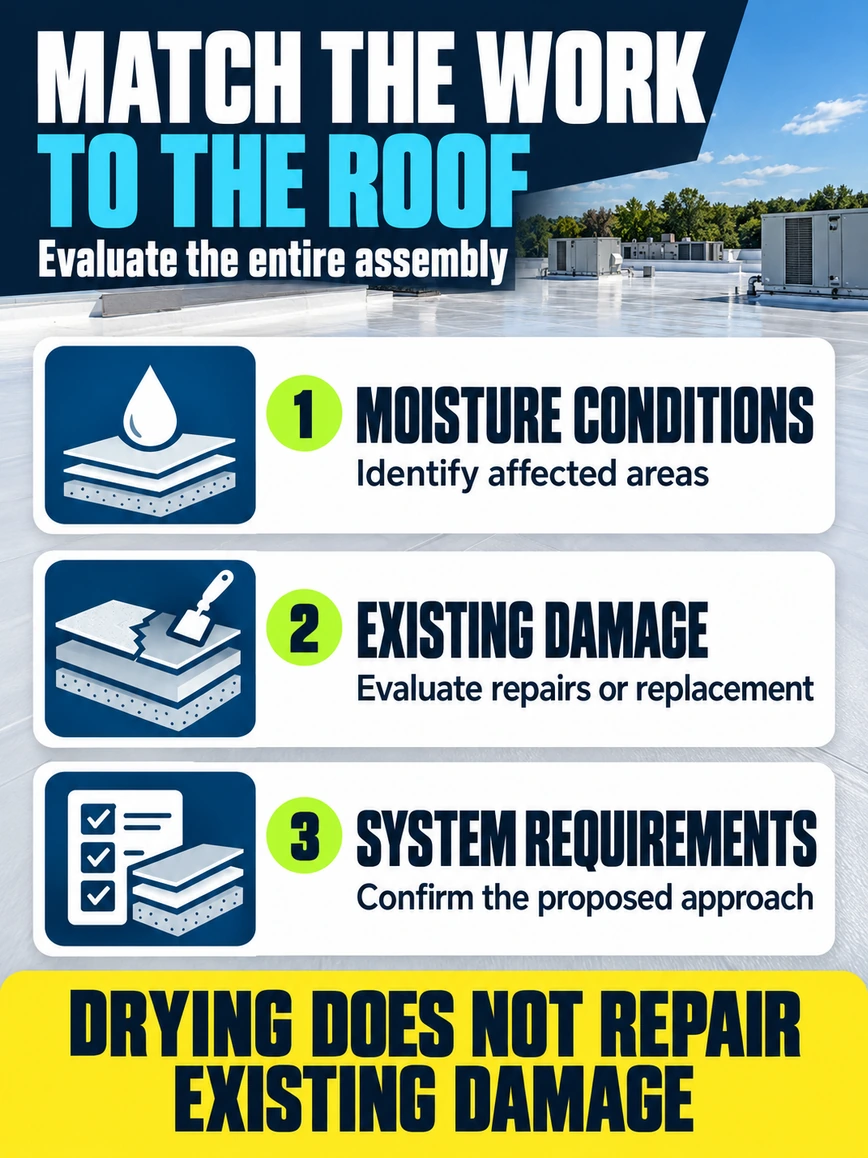
He was clear that drying does not fix damage already done to the roof. It does not repair adhesive bonds, fasteners, or corrosion. Materials that have deteriorated still need to be addressed.
That is why the assessment and discussion need to happen before the price is settled. The contractor needs to know which areas require replacement and whether drying is suitable elsewhere. The owner needs to know what the proposed work will accomplish and what problems remain.
Make the Recommendation Easier to Understand
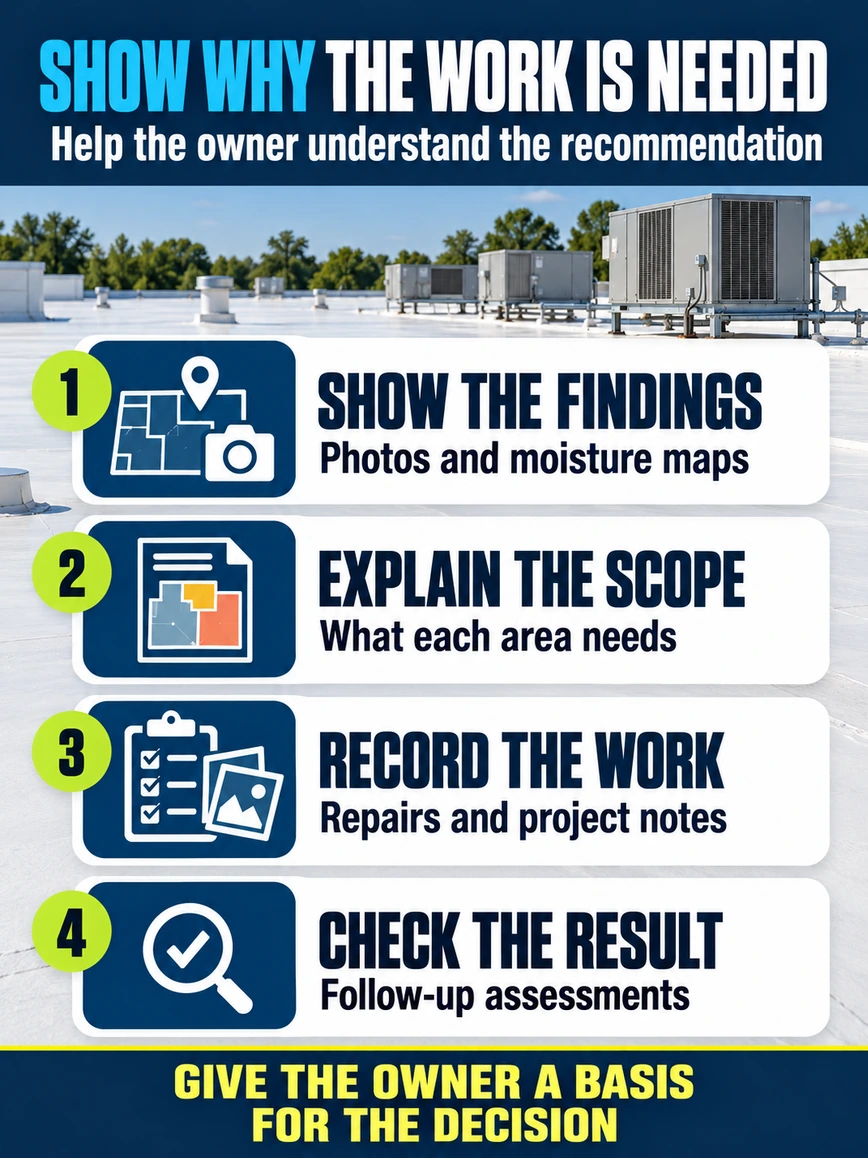 An owner cannot see most of what is happening beneath the roof membrane. Photos and moisture maps help the contractor explain where a problem was found and why it needs attention.
Adam shared a project at McCallum High School in Austin, Texas, where his slide reported a reduction from 35,300 to 14,650 square feet needing to dry. The project used 144 vents, and the maps showed changes between assessments.
There was still work to do, but the follow-up report showed how much of the affected area remained. Adam explained that ReDry returns to the roof to perform scans and report on the drying progress.
Those records can also help when a problem arises years later. Adam described investigating a roof where rooftop equipment had been added after his company’s original work. He wished he had earlier moisture records to help establish the roof’s condition before those changes.
Without those records, the contractor and manufacturer had to spend time investigating what had happened. An earlier assessment could have given them more information to compare with the conditions they found.
This is something contractors can build into their project records and maintenance visits. Keep the original findings, photos of the repairs, and follow-up assessments together. When an owner asks about a change in the roof, the contractor has a record to review instead of relying on memory.
The same information can help explain the original proposal. An owner can look at the affected areas and see where the contractor has included repairs, replacement, or drying in the price.
Help Good Contractors Make Their Case
Adam said he wants to help contractors who care about their work compete with those willing to cut corners.
We see the importance of that in our work with contractors at Choice Roof Contractor Group. A proposal that includes moisture assessment and necessary repairs may cost more than one that leaves those items out. If the owner cannot see the difference in the work, the lower price can be difficult to pass up.
Good contractors need to explain what they found and why they included the work. A moisture map, photos, and a clear proposal give the owner something to compare beyond the total at the bottom of the page.


