
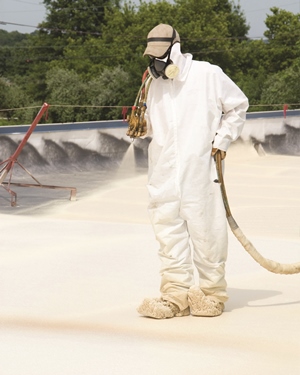
 Having been used in the United States for decades, spray polyurethane foam roofing has become an option for commercial building owners looking for roofing and insulation performance in a single system. SPF has been used over a variety of existing roof types, including built-up roofing systems and single-ply roof systems.
Like other commercial roofing systems, SPF roofing depends heavily on proper preparation and installation. The roof surface needs to be properly prepared, and the foam must be applied under suitable conditions using correctly calibrated equipment.
The protective elastomeric roof coating installed over the foam is also important. Inconsistent application or insufficient coating thickness can affect the long-term performance of the system.
With those considerations in mind, we turn to a notable case study (link) involving spray foam roofing at Texas A&M University.
Spray Foam Roofing in Action: Texas A&M University Case Study
 According to the case study, Texas A&M University began using spray polyurethane foam roofing after experiencing problems with some of its existing built-up roofing systems.
The case study reports that the university eventually had more than 7 million square feet of spray foam roofing on campus. It also describes earlier built-up roofs that experienced recurring leaks and notes that locating the sources of those leaks could be difficult during roof servicing.
The university’s physical plant team began evaluating spray foam roofing as an alternative and installed SPF systems on a number of buildings.
Almost 10 years later, the university evaluated the energy performance of spray foam systems installed on 27 campus buildings. According to the case study, the roofing applications recovered their installation costs through energy savings in an average of 4.5 years.
The university later applied SPF systems to some metal roofs as well. The case study reports favorable long-term performance from both the restored built-up roofs and treated metal roofs.
The results from this project are an example of what SPF roofing may achieve under particular building, climate, installation, insulation, and maintenance conditions. They should not be treated as guaranteed energy savings or service-life results for every building.
Potential Benefits of Spray Polyurethane Foam Roofing
Need an Expert?
Our group works together to provide:
- Larger Base of Knowledge
- Group-Wide Accountability
- One Source for All Projects
- Set Standards for Service
- More Peace of Mind
- Roofing and insulation value in a single system
- A continuous foam layer that can conform around penetrations, curbs, and other roof details
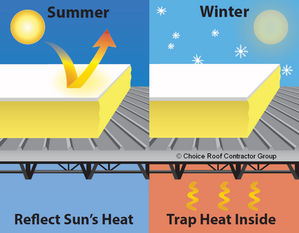
- Potential reductions in heating and cooling demand depending on the building and climate
- The ability to create or improve slope in properly designed applications
- Reduced tear-off in some restoration projects when the existing roof is suitable
- A reflective protective surface when compatible reflective coatings are used
- Repair and recoating options for some systems when conditions allow
SPF roofing is not appropriate for every roof. Before installation or restoration, the existing roof should be evaluated for wet insulation, structural deterioration, drainage problems, damaged materials, failed seams or penetrations, and other conditions that may need to be corrected first.
SPF installation also requires specialized equipment, suitable weather conditions, experienced applicators, proper foam proportioning, and consistent protective coating thickness.
The protective coating should be inspected and maintained because damage or deterioration can expose the foam beneath to ultraviolet radiation, moisture, traffic, or other conditions.
A commercial roofing contractor can inspect the building and discuss whether SPF, another restoration system, repair, recover, or replacement is appropriate.