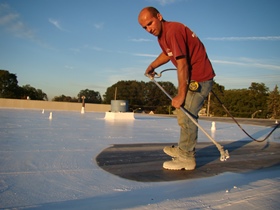
 Today’s blog post covers a type of roofing product that may be used to protect an existing commercial roof, provide reflective performance, and support roof restoration. We’re going to take a thorough look at elastomeric roof coatings.
What is an elastomeric roof coating? Simply put, it is a liquid-applied coating designed with elastic properties that allow it to stretch and recover as the roof experiences temperature changes and movement.
Elastomeric coatings can be applied over a variety of compatible commercial roof substrates, but the existing roof must first be evaluated and properly prepared. Product compatibility, roof condition, drainage, moisture, surface preparation, application thickness, and manufacturer requirements all affect performance.
Depending on the coating system and roof conditions, potential benefits can include:
- Helping extend the useful life of an existing roof when it is suitable for restoration
- Providing a flexible protective surface
- Helping protect roofing materials from ultraviolet exposure and weathering
- Accommodating some temperature-related movement
- Providing a continuous protective surface over properly prepared roof areas
- Reducing solar heat absorption when a reflective coating is used
An elastomeric coating’s ability to expand and contract can help it accommodate movement caused by changing roof temperatures. However, actual flexibility, elongation, weather resistance, and durability vary considerably among coating products and should be evaluated using current manufacturer specifications.
Other Facts about Elastomeric Roof Coatings
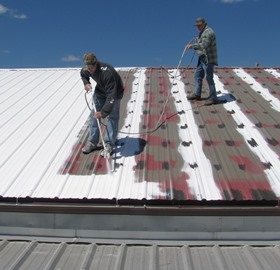 Elastomeric roof coatings are available in several chemistries. Acrylic coatings are one common type and are generally liquid-applied over a properly prepared and compatible roof surface.
When installed according to the requirements of the particular system, a coating can form a continuous, adhered membrane over suitable roof areas. Many acrylic elastomeric coatings are also available in white or other reflective colors.
A reflective white roof coating may provide additional benefits such as:
- Reflecting a portion of incoming solar energy
- Reducing solar heat absorption
- Lowering roof surface temperatures compared with a darker roof surface
- Potentially reducing cooling demand, depending on the building and climate
- Providing a continuous protective surface over properly prepared roof areas
- Reducing ultraviolet exposure to underlying roofing materials
- Potentially extending the useful life of a suitable existing roof
Actual energy savings depend on climate, insulation, HVAC efficiency, building use, roof construction, utility rates, and other factors. A reflective coating should not be expected to produce a fixed level of energy savings for every building.
Likewise, coating performance around foot traffic, ponding water, hail, weathering, dirt pickup, tensile strength, and other conditions varies by product. These characteristics should be reviewed using current manufacturer documentation.
Is an Elastomeric Roof Coating Right for Your Roof?
An elastomeric coating may be a useful roof restoration option when the existing roof is structurally sound and otherwise suitable for restoration.
Before coating, the roof should be inspected for wet insulation, structural deterioration, drainage problems, damaged roofing materials, failed seams or penetrations, corrosion where applicable, trapped moisture, and other conditions that may need to be corrected first.
The coating system should also be compatible with the existing substrate and installed at the required coverage rate and dry-film thickness using the appropriate preparation, primers, reinforcement, and application procedures.
When the roof is a suitable candidate and the coating is properly selected and installed, an elastomeric coating may provide reflective performance, a continuous protective surface, and an opportunity to extend the useful life of the existing roof.
A commercial roofing contractor can inspect the roof and discuss whether repair, restoration, coating, recover, or replacement is appropriate.


