Today we build upon previous blog posts about white roofs versus green roofs, the market for white roof coatings, and the benefits of roofs with white elastomeric roof coatings on them. Today’s blog post provides answers to what seems to be a common question in the commercial roofing industry: “Is white paint the same thing as a white roof coating?”
In short, the answer is “no.” Although both may be white and reflective to some degree, ordinary paint and purpose-made roof coatings are designed for different uses. We examine some of those differences below.
White Roof Paint Compared to White Roof Elastomeric Coatings
According to the consulting firm The ChemQuest Group, in 2007 white elastomeric roof coatings accounted for almost two-thirds, or 67 percent, of the cool roof coatings market. At the time of the firm’s report, white roof coatings were growing at an annual rate of 11-12 percent.
As people have become more aware of white roofs and their potential benefits, there has also been some confusion about the difference between simply painting a roof white and installing a roof coating system.
Aside from differences in their composition, ordinary paint and elastomeric roof coatings are designed to serve different purposes. A roof coating is formulated specifically for roofing applications and should be selected according to the existing roof substrate, climate, drainage conditions, and manufacturer requirements.
To keep things simple, here are some general differences to consider.
White Paint:
- Generally designed primarily as a painted finish rather than a roofing membrane
- Performance and durability depend on the specific paint and surface
- May provide some reflectivity, depending on the product
- May not be formulated to accommodate the movement and weather exposure expected of a roofing system
- Is not automatically a substitute for a purpose-made roof coating
- Typically applied in a thinner film than many roof coating systems
Vs.
White Roof Coating:
- Formulated specifically for roofing applications
- May accommodate roof movement depending on the coating system
- Can provide reflective and emissive properties designed for cool-roof applications
- Performance around weather exposure and ponding water varies by product
- Can provide a continuous protective surface over properly prepared roof areas
- Applied according to specified coverage rates and dry-film thickness requirements
In summary, ordinary white paint and a white roof coating should not be treated as interchangeable products. A properly selected roof coating is specifically designed for roofing applications, but its cost, service life, reflectivity, maintenance needs, and overall performance depend on the product, roof condition, preparation, installation, climate, and ongoing maintenance.
White Roof Coating and Its Performance Value
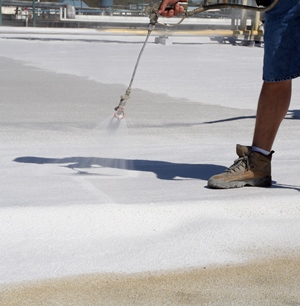 When someone is evaluating a white roof coating’s performance, it is helpful to keep these things in mind:
- What is the extent of the white roof coating’s elastomeric properties, often measured as elongation in product specifications?
- What is the white roof coating’s specified thickness when applied, commonly measured in dry mils?
- What are the white roof coating’s reflectance and emittance values?
- What substrate or existing roofing systems is the coating designed for?
- What preparation, application, and maintenance requirements apply?
- What is the extent and duration of the coating system’s warranty coverage?
Different coating products have different specifications for thickness, elongation, tensile strength, reflectance, emittance, weather resistance, maintenance, and warranty coverage. These characteristics should be compared using current manufacturer documentation and the requirements of the particular roof.
Roofing Services
Our professional commercial roof contractors provide:
- Roof maintenance & repair
- Inspections & leak detection
- Energy efficient roof systems
- Complete roof replacement
- Roof life-extending solutions
Before applying a coating, the roof should be evaluated for wet insulation, structural deterioration, drainage problems, damaged roofing materials, failed seams or penetrations, and other conditions that may need to be corrected first.
When the roof is a suitable candidate and the coating is properly selected and installed, a white roof coating may provide reflective performance, a continuous protective surface, and an opportunity to extend the useful life of the existing roof.
A commercial roofing contractor can inspect the roof and discuss whether a coating, repair, restoration, or replacement is appropriate.


