A roofing proposal can explain the system, preparation and warranty and still leave the building owner unsure what to do. The missing information often concerns the building itself: how long the owner plans to keep it, what other work needs funding, and who must approve the expense.
Gabriel Eckert, CEO of BOMA Georgia, addressed those decisions at the 2026 RCMA Fall Meeting in Atlanta. His presentation connected commercial real estate priorities with the conversations roofing manufacturers and contractors have with owners and managers. He encouraged attendees to understand the owner’s investment objectives and the people involved in evaluating a recommendation.
Listen to the key takeaways
Here is a narrated summary of Gabriel Eckert’s RCMA presentation.
Read the audio transcript
Who has to explain your roof proposal after you leave?
In his presentation at the RCMA Fall Meeting, Gabriel Eckert, CEO of BOMA Georgia, described how building owners and managers weigh a recommendation. Here are three points from that session.
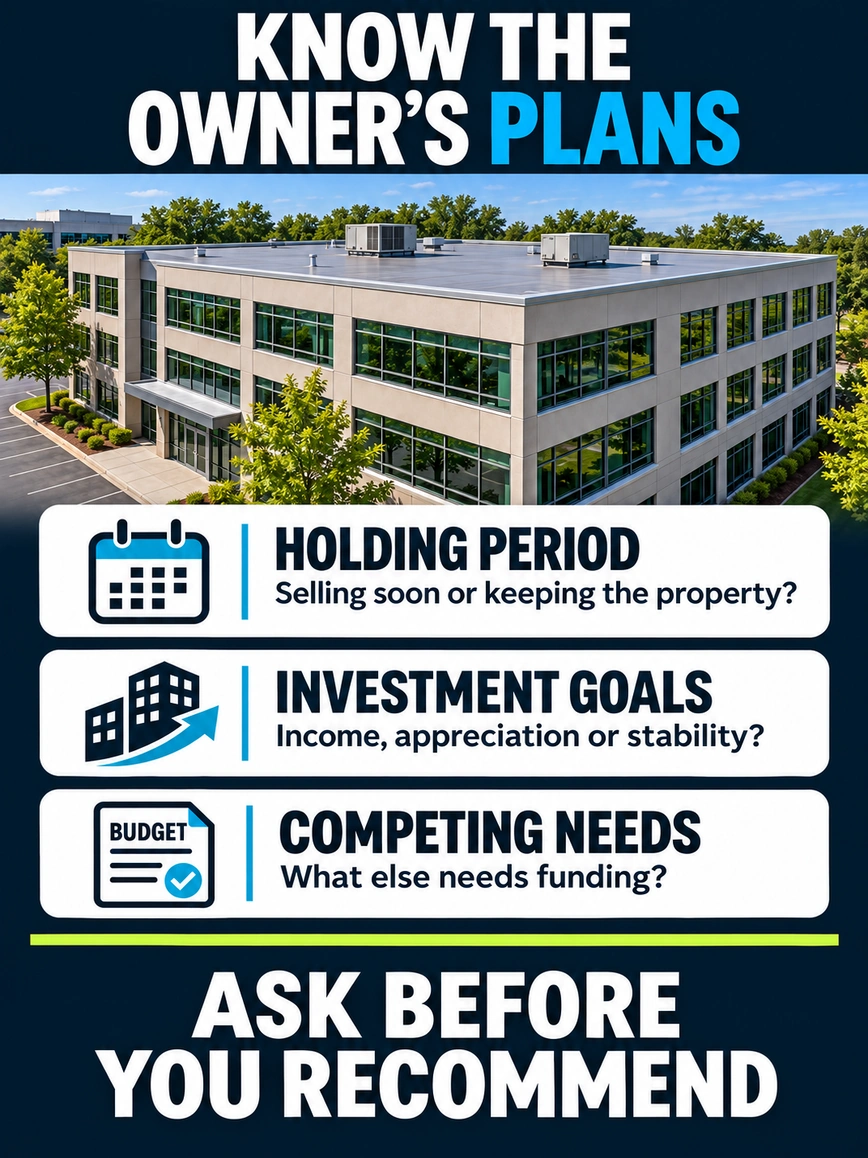
First, understand the owner’s plans. Someone preparing to sell a building can weigh today’s roofing expense differently from someone planning to keep it for decades.
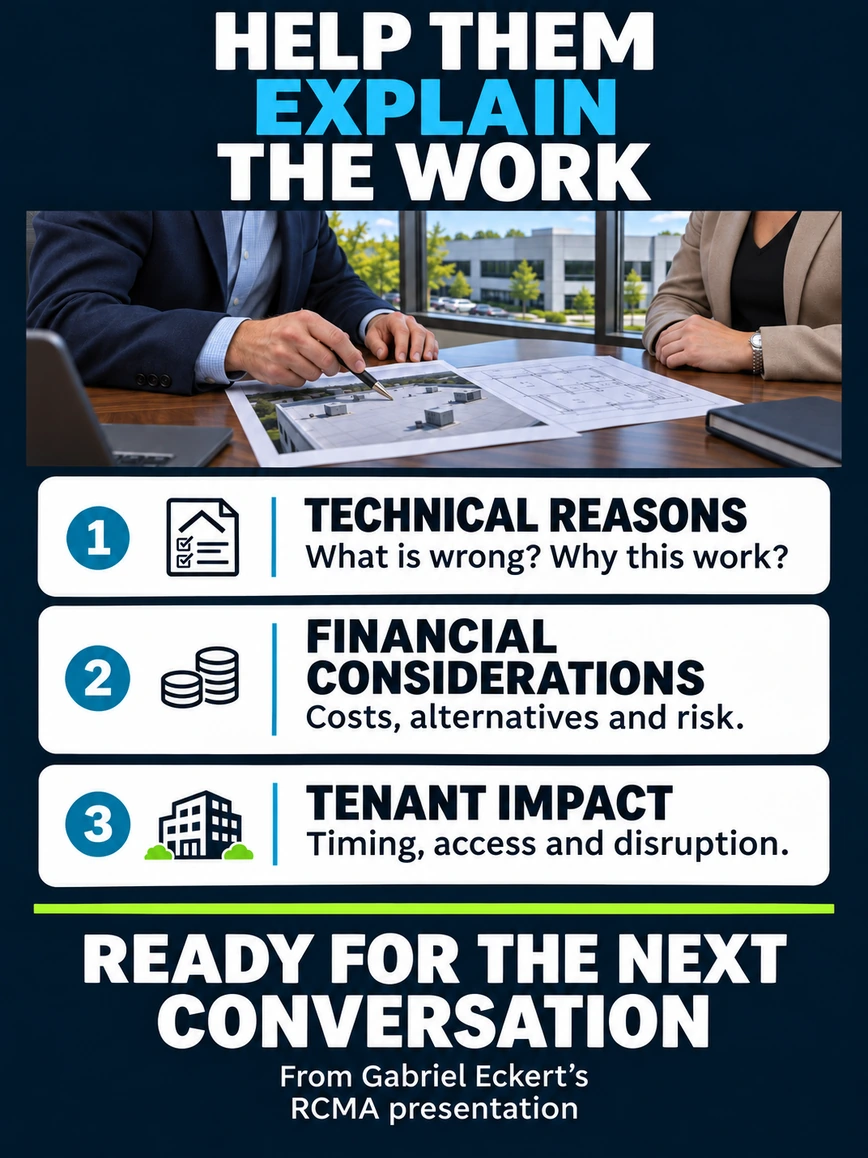
Second, help the person carrying your recommendation into the next conversation. They need to explain the technical reasoning, the financial considerations, and what the work means for tenants. A property manager deals with many building systems. Clear explanations matter.
Third, compare the options, including waiting. Eckert discussed initial and ongoing costs, disruption, risk, and how each choice fits the property’s investment plan.
Together, those points bring the conversation back to the building and the people making the decision.
This is an AI-narrated summary prepared by Choice Roof Contractor Group and 360 Commercial Roofing, based on Eckert’s presentation. It is not his voice or a word-for-word quotation.
Three questions behind the decision
- #1
What are the owner’s plans?
Investment objectives and the expected holding period shape how the owner weighs a roofing expense.
- #2
Who needs to understand?
The person recommending the work needs to explain it to others involved in the decision.
- #3
How do the options compare?
Include initial and ongoing costs, tenant impact, risk and the consequences of waiting.
The roof is part of a larger business decision
Eckert explained that owners have to consider how a building serves its occupants and performs as an investment. When they evaluate roofing work, they’re looking at more than whether it will stop the leaks. They also need to understand what it will cost to maintain and how the work will affect the people using the building.
Owners also have other demands on their money. Roofing competes with aging equipment, tenant improvements, and other building needs. Eckert explained that owners have finite capital and weigh each expenditure against other demands. He encouraged attendees to discuss the consequences of delaying a decision.
The session included a commercial real estate market overview. Its broader point was that property type, location, and quality affect the circumstances behind a purchase. A proposal for one building should not assume the priorities of another; even if their roofs are very similar.
Ask what the owner plans to do with the property
An owner planning to sell in a few years may look at roofing costs differently from someone keeping the building for decades. Eckert explained that owners with a shorter holding period may be more concerned about what they spend now, while those keeping the property longer have more time to benefit from lower operating costs. For an owner preparing to sell, explaining how the proposed work could support the property’s value can help them weigh the expense.
Eckert also discussed properties with different investment needs, from stable, well-leased buildings to assets requiring substantial improvement or a change in use. Those differences give the contractor a reason to ask about plans before presenting options.
He outlined three ownership priorities: generating revenue, pursuing long-term appreciation, and maintaining stability when a property is struggling. Understanding which objective matters helps explain why similar roofs can lead to different conversations. He encouraged attendees to keep a record of the questions they hear and how those questions differ with the property and its ownership objectives.
Understand who helps make the decision
The person walking the roof with you is not necessarily the person approving the expenditure. Eckert described a decision chain involving building engineers, property managers, asset managers, and ownership. Each can influence whether a recommendation moves forward.
A building engineer could need the technical reasoning and maintenance details. A property manager could be focused on tenant communication and how the work will affect daily operations. Ownership could need to understand the cost, risk, and fit with the property’s future plans. These are just a few starting points for questions.
Eckert encouraged the audience to help an internal advocate explain the recommendation. That person needs more than a product brochure. They need an account of the technical issue, the financial considerations, and the effect on occupants that they can carry into the next conversation.
Explain what the work will mean for occupants
Eckert used office buildings and medical facilities as examples of why contractors need to ask who uses the property. Work that causes little inconvenience in an office could be more disruptive in a medical setting. Knowing that before proposing the work helps the contractor plan around the people who will be there.
Timing also entered the discussion. Eckert noted that budget preparation places added demands on property managers. Understanding those demands, and providing information before that period becomes pressing, helps make the conversation relevant to the work already on their desks.
Give the owner a comparison they can explain
Eckert returned repeatedly to the range of available options. An owner needs to understand initial costs, ongoing costs, risk, disruption, and the fit with the investment plan. And, as mentioned before, the consequences of waiting also belong in that discussion.
He emphasized that even a strong product recommendation has to fit the ownership strategy for the asset. He encouraged attendees to explain why an option makes sense for the particular property, while helping the owner understand the alternatives.
An audience question about roof warranties brought the discussion back to risk. Eckert did not identify a universal industry standard in his response. Instead, he discussed remaining coverage in terms of exposure to potential future expenses and how an owner evaluates that exposure.
Listen to the questions, then improve the explanation
One of Eckert’s most transferable suggestions was to keep a record of the questions different people ask. Over time, those questions show where explanations are missing and how concerns differ by property and role.
He also cautioned against overwhelming a property manager with technical language. Property managers deal with many building systems, along with leasing, security, and tenant concerns. Start with the issue and its effect on the property, then provide the supporting detail.
Eckert also suggested raising common questions that have not yet been asked, since another person in the decision process could raise them later. His closing discussion emphasized listening for the kind of information someone needs: facts, process, the effect on people or longer-term consequences. An explanation focused entirely on technical details can miss a listener’s concern about tenants or the property’s future.
Frequently Asked Questions
Why do ownership plans matter in a roofing conversation?
Eckert explained that investment objectives and the expected holding period influence how an owner weighs current spending, ongoing costs and the value of a proposed improvement.
Who influences a commercial property’s roofing decision?
The session described a chain involving building engineers, property managers, asset managers and ownership. The final person making the approval is only one part of that process.
What information helps someone explain the recommendation internally?
Eckert emphasized technical, financial and tenant-impact information. The explanation needs to be understandable to people who bring different concerns to the decision.
What did the session recommend tracking after customer conversations?
Keep a running record of the questions people ask, including how those questions differ by role, property and ownership objectives. Use the record to improve future explanations.
This article is based on Gabriel Eckert’s presentation and its audience discussion at the 2026 RCMA Fall Meeting. Read our meeting recap for the wider event coverage.


