Changes in Traditional Materials
For many years, traditional built-up roofs, composed of layers of roofing felts and bitumen, were the mainstay of the roofing industry.
 During the energy crisis of the early 1970s and recent energy concerns, the material used in built-up roofs declined in quality. During refining, more of the petroleum-based chemicals used in asphalts were extracted for use in gasoline and other more profitable items. The content of roofing felts also changed. Felts originally contained natural rag for strength and flexibility. But today, felts contain synthetic fabric and fibers, lowering the performance standard.
Changes in Performance Expectations
Today, it has become common practice to increase insulation thickness to reduce heat flow. With substantial insulation as part of most roofing systems, increased thermal stresses due to membrane heat gain, expansion rates and compatibility are placed on the built-up roof.
Emergence of Liquid-Applied and Single Ply Systems
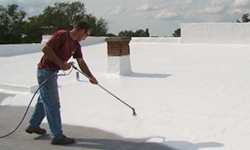 As a result of changes and performance-related issues with built-up roofs, new options became prominent in the market. One option that drew considerable attention was the liquid-applied system. Seamless or monolithic application, lightweight materials and reflective surfaces helped liquid-applied systems gain momentum in commercial roofing. Architects, after years of specifying primarily traditional built-up roofs, also became more receptive to new systems and techniques. Single-ply membranes became another choice for many commercial projects due to their ease of application, various methods of attachment, durability and relatively low cost.
Why Contractors Join Our Network
- Lead Generation
- Mentorship Program
- Complete Training
- Discounted Pricing
- Marketing Support
Roofing Design: An Overview
To the roofer, the basic design of a roof is the first factor that comes into play. The roof design is important because it either implies a system that successfully handles the demands placed on it, or one that chronically fails. Most architects and engineers rely on the advice of a select few local roofing professionals when designing buildings. This helps ensure that the design of the roof is executable.
Ideally, each roof design reflects a team approach with the roofer, architect and general contractor working to develop a viable system. Because of the technology and skills unique to each profession, all three parties have input in the final design.
The History of Drainage Problems
In the early 1920s, American architecture became strongly influenced by the Bauhaus School of Design in Germany. This concept called for sleek, severe lines topped with a flat or minimally-sloped roof. While this concept is still popular among designers today, it is considerably less popular with roofers and contractors.
Low-slope roofs require careful drainage design because accumulated snow or standing water can add significant load and contribute to roofing problems. If drainage problems are not corrected, the resulting conditions can damage the roof system and, in severe circumstances, may create structural concerns.
When the roofer’s desire for adequate drainage and the designer’s creative concepts are in conflict, it is important that the roof be designed so water can move efficiently toward the intended drainage system. Some of the ways this can be accomplished are described later in the Surface Preparation section.
Industry Standards
Over the years, the Army Corps of Engineers, Building Officials and Code Administrators, the Department of the Navy, the National Roofing Contractors Association and other roofing organizations have published recommendations and guidance relating to roof drainage. Examples discussed in roofing literature have included:
- A minimum slope of ¼” per linear foot of roof in many low-slope roof applications.
- The use of appropriately designed interior drains, scuppers, or other drainage components based on the building, climate, applicable codes, and roof design.
- The use of expansion joints where required by the building and roof design.
Other drainage recommendations have addressed matters such as the number of drains, spacing between drains, and drain sizing. These requirements should be determined according to the applicable building and plumbing codes, roof area, drainage design, rainfall conditions, and project requirements rather than by one universal rule.
An adequate slope helps direct water toward the roof’s drainage system. If a crown or peak is designed into the center of the roof, scuppers or other drainage components may be spaced around the perimeter as required by the design. Interior drains, incorporating slope in the central areas of a roof, are another way to improve drainage.
One effective way to establish drainage is for the designer to slope the structural frame during construction. Other alternatives include spray-in-place polyurethane foam, lightweight insulating concrete and tapered boardstock insulation, which may be used to create slope and, depending on the material, provide insulation. The suitability and amount of these materials should be determined as part of the roof and structural design.
Professional Associations
There are a number of sources of information that provide the knowledge and training to start you on your way as a roofing contractor. Through seminars, magazines, newsletters and conventions, they promote the exchange of ideas and technology among members with the goal of nurturing a healthy economic climate for roofing and construction, and fair standards for labor, workmanship and pay.
NRCA
The oldest and best known of these organizations is the National Roofing Contractors Association (NRCA). With a membership of over 2,900 contracting groups, representing all fifty states plus twenty-eight foreign countries, the NRCA is dedicated to the advancement of the roofing industry and serves contractors engaged in the installation of roof decks, coatings, and waterproofing materials. A variety of programs are offered to members, including trade publications, educational seminars, management conferences, safety reports, insurance, technical information and a national convention/tradeshow each February.
O’Hare International Center
10255 W. Higgins Rd, Suite 600
Rosemont, IL 60018-5607
Phone: (847) 299-9070
Fax: (847) 299-1193
RIEI
The Roofing Industry Educational Institute (RIEI) provides objective and current technological information about quality roof design, materials and applications.
10255 W. Higgins Rd, Suite 600
Rosemont, IL 60018-5607
Phone: (847) 299-9070
Fax: (847) 299-1183
SPRI
The Single Ply Roofing Institute (SPRI) is another nonprofit organization founded in 1982, comprised of manufacturers and marketers of sheet-applied membrane roofing systems.
77 Rumford Ave, Suite 3B
Waltham, MA 02453-3872
Phone: (781) 647-7026
Fax: (781) 647-7222
Spray Polyurethane Foam Alliance
Spray Polyurethane Foam Alliance (SPFA) is a national trade organization which focuses on key issues and events in the spray-applied urethane foam industry. The SPFA holds an annual convention in February to keep foam contractors abreast of technology and other matters of interest. Membership is open to all interested parties.
4400 Fair Lakes Court, Suite 105
Arlington, VA 22033-3801
Phone: (800) 523-6154
Fax: (703) 222-5816
Western States Roofing Contractors Association
The Western States Roofing Contractors Association (WSRCA) has been shaping the western states’ roofing profession since 1974. Their 800 members are educated, professional roofing contractors and industry-related associate members including manufacturers, distributors, architects, consultants, engineers and various other segments of the roofing and waterproofing industry, who are committed to providing the highest quality service to customers.
1098 Foster City Boulevard, Suite 204
Foster City, CA 94404-2300
Phone: (650) 570-5441
Fax: (650) 570-5460
Midwest Roofing Contractors Association
The Midwest Roofing Contractors Association (MRCA) is an association of roofing contractors who have joined together to develop and administer programs and services that help member companies build their business and save them money, while continually working to improve the roofing industry.
4840 Bob Billings Pkwy, Suite 1000
Lawrence, KS 66049
Phone: (800) 497-6722
Fax: (785) 843-7555
Other organizations of importance to new contractors include the local Better Business Bureau and the Small Business Administration, whose purpose is to assist in financing and advertising start-up businesses and to oversee the successful operation of existing small businesses.


