 Today’s blog post focuses on the benefits of seamless roofing systems. Building owners, facility managers, and property management firms may find this information particularly helpful alongside our prior post on fully adhered roofing.
In the commercial roofing industry, membrane roof systems such as TPO, PVC, EPDM, and modified bitumen are common choices for building protection. These systems typically include seams, transitions, penetrations, and other details that need to remain properly sealed and maintained over time.
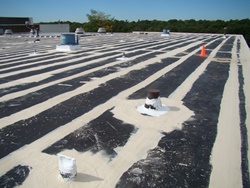
Liquid-applied roofing offers another approach by creating a continuous membrane over properly prepared roof areas.
What is Seamless Roofing?
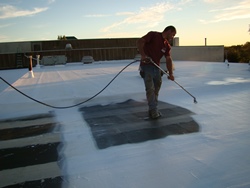 Simply put, seamless roofing generally refers to a roof surface that forms a continuous, or “monolithic,” membrane rather than being assembled from separate sheets joined by field seams.
The term is commonly associated with liquid-applied roofing systems, including roof coatings. When properly selected and installed, these systems can form a continuous protective surface over an existing roof.
That does not mean a seamless roof is automatically free from leak risk. Penetrations, transitions, flashings, drains, terminations, substrate conditions, installation quality, and maintenance still play important roles in long-term performance.
Benefits that Seamless Roofs Deliver
Liquid-applied roofing products can form a continuous protective surface over a properly prepared commercial roof. Some potential benefits include:
- They may help address existing leak-prone areas. Roof leaks can develop at seams, penetrations, flashing, curbs, drains, damaged materials, and other vulnerable locations. As part of a properly designed restoration project, these areas can be repaired and detailed before a coating is applied. The coating can then provide a continuous protective surface over the repaired roof areas.
- They can reduce the number of field seams on the finished surface. Sheet-membrane roofing systems rely on properly constructed seams and details. Liquid-applied systems do not have the same type of field seams across the coated surface, which can reduce some potential pathways for water entry. However, penetrations, transitions, drains, and roof edges still require proper detailing.
- They can conform to complex roof details. Liquid-applied materials can be useful around properly prepared penetrations, curbs, flashing transitions, and other irregular roof areas where careful detailing is important. These areas should still be repaired and reinforced as required by the selected system.
- They may simplify some future repairs. Because a coating system is applied directly over the existing roof surface, localized damage may sometimes be easier to identify and repair. However, leak tracing can still be complicated if water travels through the underlying roof assembly, insulation, deck, or other components.
- They may reduce tear-off and disruption when restoration is appropriate. If the existing roof is structurally sound and otherwise suitable for restoration, a liquid-applied system may allow much of the existing roof to remain in place. This can reduce tear-off, disposal, material use, and some project disruption compared with full replacement.
A seamless coating system should not be expected to correct every roofing problem. Before restoration, the roof should be evaluated for wet insulation, structural deterioration, drainage problems, widespread membrane damage, failed seams or penetrations, trapped moisture, and other conditions that may need to be corrected first.
Evaluating a Seamless Roof Coating System
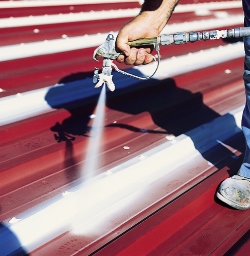 When a roof is a suitable candidate for restoration, a properly selected liquid-applied coating system may offer benefits such as:
Roofing Services
Our professional commercial roof contractors provide:
- Roof maintenance & repair
- Inspections & leak detection
- Energy efficient roof systems
- Complete roof replacement
- Roof life-extending solutions
- Elastomeric properties that allow some systems to accommodate temperature-related movement
- A continuous protective surface over properly prepared roof areas
- Reduced solar heat absorption when reflective coatings are used
- Potential reductions in cooling demand depending on the building and climate
- Reduced tear-off and disposal when restoration is appropriate
- Potential extension of the existing roof’s useful life
- Repair and recoating options for some systems when conditions allow
Performance varies by coating chemistry, roof substrate, preparation, application thickness, drainage, climate, maintenance, and installation quality. Warranty terms, reflectivity, fire ratings, wind or hail performance, and other characteristics should be evaluated using current manufacturer documentation for the specific system being considered.
A commercial roofing contractor can inspect the existing roof and discuss whether repair, restoration, coating, recover, or replacement is appropriate.


