 Today’s blog post will be of interest to commercial real estate owners, facility managers, and property management firms. What are the things to keep in mind when you are looking for the right commercial roofing products for your building?
To help you, we have prepared a list of factors to consider. Read on below for some brief thoughts to keep in mind when you are shopping around for the right solutions for your building.
Factors to Consider When Choosing Roofing Products
What is the height of your building? A building with several stories will be subject to heavier wind loads than a building with only one or two stories. Wind uplift resistance will be a factor (and by extension, how the roofing products will be adhered to the building). It will also affect roof accessibility and the roofing contractor’s ability to transfer materials, debris, and tools on and off the rooftop – points which weigh on roofing materials that are transferable to buildings of greater height.
Where is the building location? Building location is another point with many dimensions to it. Factors such as local, regional, or state compliance standards and work standards come into play. Things to keep in mind include:
- Relevant, applicable building codes
- Fire code requirements set by state and/or local authorities
- Building energy codes or compliance standards
- Applicable local ordinances, such as ones relating to permitted work hours or sound levels at different times of day
What is the local climate like? Local climate is of tremendous importance. When selecting roofing products, it is advisable to keep local conditions in mind. These include annual precipitation patterns, temperature ranges throughout the year, any patterns of high-wind activity, and whether the area tends to have a warmer or colder climate. For instance, buildings in areas with warmer conditions, such as the southern United States, will strongly benefit from energy-efficient roofing products. Other regions with more demanding climates, such as the northeastern United States, will require roofing products that can stand up to abuse and preferably have high insulation value.
What are your building’s and roof’s characteristics? Commercial buildings differ in terms of their architectural design, rooftop features and protrusions, operating purpose, and more. Because each building is unique, it important to be sure that any roofing products used on your building are best-suited for your property’s specific features. Things to keep in mind include:
- The number of protrusions your roof has
- Any rooftop units or features, such as HVAC systems, piping, electronic equipment, and others
- The presence of any parapet walls, or walls extending beyond the roof line
- The scale of your building size
- Existing roof construction and water drainage measures or systems
- Whether your roof is made up of a singular body, or broken up into small sections
- Your roof’s structural capacity
- Whether the building is a manufacturing or industrial plant, and has any output like chemical agents that come out on the rooftop
Be sure to consult with professional building engineers and roofing service providers so you are fully apprised of your options.
The Importance of Reputation
Choosing a commercial roofing system means making decisions that will affect your building’s performance, safety, and efficiency for years to come. By taking into account factors such as building height, location, climate, and structural characteristics, you can better determine which products are most appropriate for your property.
Ultimately, working with experienced roofing professionals and selecting products from reputable manufacturers will help ensure reliable, long-term performance. Taking the time to carefully evaluate your options now can help reduce the likelihood of costly repairs and disruptions in the future.
 There are many opportunities in commercial roofing. In just 2014 alone, commercial roofing sales are expected to top off at $5.3 billion. Plus, in the future, the nationwide commercial roofing market is projected to reach new heights.
 People have taken our sales tips and completely transformed their roofing companies. Contractors have even added six-figure revenue streams to their bottom line as early as their second year of using the products we represent from Conklin. And we provide these exclusive, proven, insider tricks-of-the-trade to you complete with a dinner featuring some of the best steak in all of Kansas City.

 We’re currently halfway through the first day of Conklin’s product training at their Kansas City headquarters and having a great time with 9 different individuals who came out from as far as Florida to meet us personally and join our nationwide group of commercial roof contractors.
 Two other contractors arrived later in the day, so to get them up to speed, we went to a different restaurant and had some more great Kansas City food while getting to know each other well. It was well after 11pm before we wrapped things up, but still have a lot more to cover.
 • The best marketing strategies for getting started quickly and cost-effectively
 If you’re interested in expanding your roofing company, there are some great opportunities in commercial roofing. Just one commercial job can deliver the payout of 50 residential jobs. And the commercial roofing industry is growing. It’s expected to reach $5.3 billion this year and balloon to new heights in the years ahead.
 For those new to the scene, one big challenge is winning out over those with years of commercial roofing experience. It’s not unusual for experienced contractors to be among the competition on larger-scale jobs.
 If you don’t have any proven method of getting large jobs: no sweat. Our veteran contractors will share their own experiences with the approaches that work best, that don’t, and that are the most cost-effective. In recent efforts, our dedicated mentors have helped members secure the beginning phase of roofing projects as big as 400,000+ square feet.

 One sizable hurdle facing new contractors is how to handle new business or roofing situations. It’s yet another area where experienced commercial contractors have the advantage.
 Complex commercial roofing problems are faced on a regular basis by architects, building owners and roofing contractors, especially today when rising energy costs and environment awareness are important considerations when installing a new roof or doing extensive roof repair. Asking the right questions can help discover proper and simple solutions that will satisfy the need for quality roofing, and ensure that energy costs can be contained and environmental issues addressed.
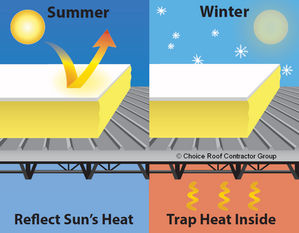 Energy efficiency can be greatly influenced by the type of insulation used and can be a great factor when it comes to energy savings than the roof color. Problems associated with condensation can be eliminated in part due to how many layers of insulation are applied.
 A proper roof system design and installation is the first step in not only meeting applicable code requirements, but also in taking control over roof system durability and longevity. Building codes establish minimum requirements for weather protection, materials, insulation, reroofing, fire resistance, and other aspects of roof-system performance.
 Drainage is an important part of commercial roof design. Localized areas of poor drainage or ponding should be evaluated and addressed rather than relying on the roofing membrane alone to manage standing water. Depending on the roof design, tapered insulation, crickets, saddles, drains, scuppers, or other measures may be used to help move water toward appropriate drainage points.
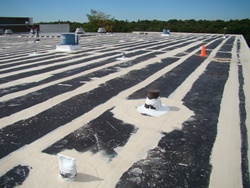 Today’s blog post focuses on the benefits of seamless roofing systems. Building owners, facility managers, and property management firms may find this information particularly helpful alongside our
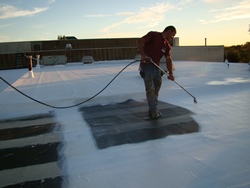 Simply put, seamless roofing generally refers to a roof surface that forms a continuous, or “monolithic,” membrane rather than being assembled from separate sheets joined by field seams.
 When a roof is a suitable candidate for restoration, a properly selected liquid-applied coating system may offer benefits such as:
 Before getting into the details: a little background on KCI Roofing. Based out of central Georgia, KCI Roofing has been in the roofing industry for 50 years. They have steadily grown into a large residential roofing company, and have done as much as $12 million in annual sales, with 25 salespeople and offices in multiple states. Having built up a strong presence in residential roofing, they have now turned to
 Just a few weeks ago, KCI Roofing received a 54,000 square foot roofing lead from us. And having reached out to old connections, they have begun opening up doors to look at many other commercial roofing projects, as well.
 When asked for his thoughts on what has happened, Shane shared that he is impressed with the extent to which our network has helped them in their efforts. Now he and his team are much stronger and more confident in approaching commercial prospects, in carrying out effective sales presentations for interested prospects, and in their overall commercial roofing knowledge.
 The life of a roofing contractor is a busy one. It is also hard work resulting in plenty of headaches and sore muscles. Anyone in this industry is usually characterized as a breed onto himself or herself because they find the work rewarding despite the long hours and physical aches. They enjoy working with their hands and creating functional structures that stand the hardships of time and weather.
 Change is inevitable in most things encountered in life, but more so when it comes to business because we are such creatures of habit and there is usually a price tag associated with changes in the workplace. We find it difficult to change the way we do things, especially when how we have done it in the past yields results that are acceptable. New technologies, and new expectations from owners can lead to a necessary change in regards to materials used, tools or labor.
 Common requirements of running a successful business can become a mental drain, especially for someone who would rather be outside working instead of pushing pen and paper. A successful business has to involve a high level of organization to run smoothly. Being disorganized is a common reason for business failure and can dismantle the passion a person experiences for being an entrepreneur.
 Many roofing contractors, especially when they are new in business, lack the knowledge or experience to bid successfully on bigger jobs. They have the passion for growing a business and this requires successfully pulling in larger roofing contracts. In order to be the successful bidder, they have to have the proper combination of price, materials and labor. We all dream big and want to see our dreams come true quickly, but the truth is it takes a lot of support to win the first round of large roofing contracts.
 Today’s blog post provides an overview of the potential benefits involved with
 • Continuous protective surface. EPDM roofs commonly include seams and other transitions that require proper detailing and maintenance. Over time, seams, flashing, penetrations, or other areas may become vulnerable to water intrusion if they deteriorate or are damaged.
 • Potential for improved reflective performance. Many EPDM roofs are dark in color and can absorb substantial solar heat. A compatible white or reflective coating may reduce solar heat absorption and lower roof surface temperatures.
